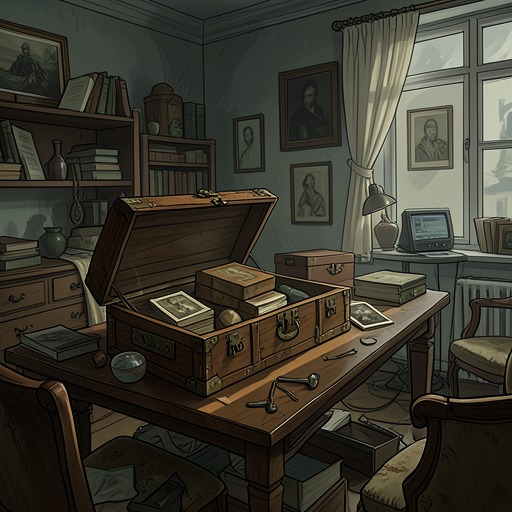
Letizia Calabrò’s photographic archive
The HummingbirdLetizia Calabrò’s photographic archive is at once a substantial record of twentieth-century artistic life and a family document that unsettles the son who inherits it. Marco Carrera first experiences its thousands of photographs as a painful, even jealous, portrait of a world from which his father seems absent. By arranging for the collection to go to the Dami Tamburini Foundation as a donation, he preserves his mother’s work—and discovers, within it, a single image of his father among the flood of prints and negatives.
Contents and Family Context
The archive comprises thousands of photographs made by Letizia Calabrò, an architect and photographer whose work placed her among architects, designers, and artists. It contains hundreds of striking black-and-white portraits, including a section on women architects that Marco judges close to being the most complete in Italy. Other sequences follow plastic objects such as lamps, chairs, and tables from studio design to factory production; the archive also documents exhibitions and events associated with radical architecture groups in the 1960s and 1970s, as well as many visual-poetry gatherings.
Its breadth is part of what makes the collection difficult for Marco to approach. He wonders whether some of the men in the portraits had been his mother’s lovers, and sees an expansive social and artistic world—full of people, talent, objects, music, and landscapes—in which his father, Probo Carrera, appears to have no place. By contrast, Probo’s own pursuits, including his collection of Urania science-fiction novels and his models, seem to Marco to have formed a solitary world that excluded his mother. The archive therefore seems to hold not only Letizia’s work but also the imbalance and distance of her marriage.
From Avoidance to Recognition
Marco admits that he did not properly care for the archive for a long time. Its photographs embarrassed him and sometimes hurt him; rather than sorting through the material, he left it among his mother’s belongings. The archive became an unresolved part of the family home at Piazza Savonarola, a house he periodically checked but did not bring himself to put in order.
The prospect of selling the house eventually makes the archive’s future urgent. Marco’s first practical breakthrough is not the result of a planned archival project: after winning a charity doubles tournament with Luigi Dami Tamburini, he is invited to dinner at Dami’s villa in Vico Alto and hears about the Dami Tamburini Foundation, which collects private photographic archives and other material connected with twentieth-century iconography. Marco tells Dami about his mother’s photographs. Dami arranges for him to speak with the Foundation’s president, who promptly sets an appointment to view the collection.
Taking the archive out to show it forces Marco to examine it closely for what he says is the first time. The change is consequential: what had seemed to him an emotionally loaded mass of photographs becomes legible as a remarkable body of work. The appointment does not simply secure a destination for the collection; it alters Marco’s understanding of what his mother had made and what preserving it might mean.
The Photograph of Probo
Among the archive’s sections, Marco is especially moved by the photographs documenting the 1966 flood in Florence. He had not known that his mother had assembled this record of the mud angels. In one photograph, and only one, he recognizes Probo: wearing boots and a cape, he stands in front of the National Library beneath a lamp that illuminates his smiling face and the cigarette between his lips.
The image revises the apparent absence that had distressed Marco. His father is not present throughout the social and artistic world recorded in the archive, but he has not been entirely excluded from its history. The photograph is a small, singular trace of Probo inside the collection Letizia made over a lifetime. Marco calls it a miracle that he and his brother were born; in context, the discovery also makes the archive a place where the family’s separate lives briefly meet. The photograph does not erase the distance Marco has perceived between his parents, but it gives that distance a concrete exception, preserved among the negatives and prints.
Donation and Preservation
The Foundation’s president offers Marco twenty thousand euros for the archive. Marco refuses the payment and insists that the transfer should be a donation: he understands the institution’s acceptance as a favor to him, not a purchase. The president appears surprised by his refusal, and Marco suspects that the man is disappointed. He also suspects that the president might have been looking for an opportunity to involve him in something dishonest, though Marco presents this as an intuition rather than a provable fact.
The collection becomes the Letizia Calabrò donation to the Dami Tamburini Foundation. Its transfer gives the photographs an institutional home and prevents the record of his mother’s work from being lost with the house or dispersed through a sale. The house at Piazza Savonarola can now officially be put on the market, although its real-estate agent warns that the market has collapsed after the subprime crisis and stock-market turmoil. Marco is not willing to sell cheaply: if the price is right, he will sell; otherwise, he will wait. His patience in this matter contrasts with the finality of the donation. The archive has a destination, even while the house remains unresolved.
Archive, Memory, and Inheritance
The archive matters because it is neither a neutral inventory nor a simple emblem of a harmonious family past. Its photographs preserve professional work and artistic communities, but they also provoke Marco’s suspicion, pain, and jealousy. Their abundance initially intensifies his sense that Probo had no place in Letizia’s world; the single flood photograph complicates that conclusion without making the two parents’ lives appear identical.
The act of preservation is also an act of belated attention. Marco’s earlier discomfort had kept him from seeing the collection’s artistic and documentary value. Handling it for the Foundation’s visit allows him to encounter its contents, including the record of the flood and the one image of his father. By giving the archive away without compensation, he separates its survival from his own financial gain and from the fate of the family home. What remains is not a complete explanation of his parents’ marriage, but a carefully preserved record in which the mother’s public world and the father’s rare, startling appearance coexist.